


Nossos serviços estão apresentando instabilidade no momento. Algumas informações podem não estar disponíveis.
-
Home

-
Statistics
-
Social
-
Education
- NP-Novo Portal
Population Census
About - Preliminary Synopsis
It presents preliminary data from the 2000 Population Census, with information about the population in Brazil and in its metropolitan areas, including comparative tables showing previously-conducted censuses, as well as resident population and househing units, by Federation Units and municipalities.
Main results - Preliminary Synopsis
#tabelasidra201763151633383
The IBGE adopts a review policy of the data disclosed by this statistical operation. Data review means any and all scheduled revision of numerical data due to new information, which was not accessible at the time of the first disclosure. For instance: late data that replaces a non-response; or data corrected by the informant himself; or a set of data that has undergone editing and imputation. For more detailed information about the published data review policy of the IBGE statistical operations, check the list of short-term, long-term and special surveys carried out by the Institute with their respective revision procedure on: https://biblioteca.ibge.gov.br/index.php/biblioteca-catalogo?view=detalhes&id=298009.
Tables - Preliminary Synopsis
Tables
The IBGE adopts a review policy of the data disclosed by this statistical operation. Data review means any and all scheduled revision of numerical data due to new information, which was not accessible at the time of the first disclosure. For instance: late data that replaces a non-response; or data corrected by the informant himself; or a set of data that has undergone editing and imputation. For more detailed information about the published data review policy of the IBGE statistical operations, check the list of short-term, long-term and special surveys carried out by the Institute with their respective revision procedure on: https://biblioteca.ibge.gov.br/index.php/biblioteca-catalogo?view=detalhes&id=298009.
Publications - Preliminary Synopsis
Sinopse preliminar do censo demográfico : 2000
Material type: Journal
Year: 2000
Description
It is the main reference source about the living conditions of the population in all the municipalities of Brazil and in their internal territorial divisions, having the resident person in the housing unit in the National Territory, on the reference date, as the data collection unit.
The first enumeration of the Brazilian population was conducted in 1808, in order to meet military interests, of enlisting people in the armed forces. Because of this specific objective, and of the population’s suspicions about census operations, it is believed these results did not reflect reality. For the sake of historical records, the enumeration of 1872, called General Census of the Empire, which was a more complex and better controlled operation, is considered the first census of Brazil, under the responsibility of the General Directorate of Statistics.
In 1940, after a radical transformation of the structure of statistical services in Brazil – creation of the National Council of Statistics – CNE and of the National Council of Geography – CNG, which became part of the IBGE by means of Decree-Law No. 218, of January 26, 1938 – the Institute conducted, on September 1st, the 5th General Enumeration of Brazil, which corresponded to the fifth population census. Since then, a number of technical, technological and operational aspects of the survey have been changed and improved, resulting in a leap in quality of the survey. Two of the main changes were the establishment of partnerships, aimed at the expansion of integration between the IBGE and local communities, and the intensive use of digital technologies that allow each segment of users to access the most appropriate media.
The Basic Questionnaire of the survey consists of 26 questions and investigates the main characteristics of the housing units and of residents. In addition to that, a share of the housing units is selected to answer the sample questionnaire, with 77 questions. The investigation of selected housing units, by means of the Sample Questionnaire, includes, besides the items found in the Basic Questionnaire, other detailed ones on specific topics: characteristics of housing units, ethnic-racial identification, nuptiality, family unit, fertility, religion or cult, disability, internal or international migration, education, commuting to study, labor and income, commuting to work, mortality and autism.
The periodicity of the survey is decennial, except for the years of 1910 and 1930, in which the survey was canceled, and of 1990, when the operation was postponed to 1991, and the year of 2020, when data collection was postponed due to the COVID-19 pandemic. The census is a survey of geographic coverage, with results released for Brazil, Major Regions, Federation Units, Mesoregions, Microregions, Metropolitan Areas, Municipalities, Districts, Sub-districts and Enumeration Areas.
Data collection for the next Population Census will take place from August to October 2022. A total of 78 million permanent private housing units in the country will be enumerated. The sample questionnaire will be administered in approximately 11% of this total, that is, approximately 8.5 million housing units. For more detailed information, visit censo2022.ibge.gov.br.
Time series
#tabelasidra2018731246098
#seriehistorica20187312484678
#seriehistorica201873125221541
#seriehistorica20187312541828
...
Microdata
The microdata are the lowest level of disaggregation of the data of a survey, representing, in the form of numerical codes, the content of the questionnaires and preserving the statistical confidentiality aiming at the non-individualization of the information. The microdata are in ASCII format, allowing expert users with knowledge in programming, preferably in statistical software, to read the data, cross them in different geographic aggregations and create multiple tabulations according to their personal interest.
The microdata files are coupled with a support documentation that provides the names, codes and descriptions of the variables and their categories, complemented, whenever needed, with elements to compute the sampling errors.
2010 Census
Updating
March 11, 2016 - Variable v1005 - ENUMERATION AREA STATUS was included in the HOUSING UNIT, PERSON, EMIGRATION and MORTALITY files
Federation Units
Tables - Federation Units and Municipalities (in zip format)
- Rondônia
- Acre
- Amazonas
- Roraima
- Pará
- Amapá
- Tocantins
- Maranhão
- Piauí
- Ceará
- Rio Grande do Norte
- Paraíba
- Pernambuco
- Alagoas
- Sergipe
- Bahia
- Minas Gerais
- Espírito Santo
- Rio de Janeiro
- São Paulo - except MA
- São Paulo - MA
- Paraná
- Santa Catarina
- Rio Grande do Sul
- Mato Grosso do Sul
- Mato Grosso
- Goiás
- Federal District
- Microdata for the 14 municipalities with redesigned areas
- updated on March 31, 2016 - variable v1005 - ENUMERATION AREA STATUS was included in the Variable description files - Microdata of the sample of the 2010 Population Census - updated on March 15, 2016
- variable v1005 - ENUMERATION AREA STATUS was included in the Layout_microdados_Amostra_14_munic_20160301 file, in the sub-folders of HOUSING UNIT, PERSON, EMIGRATION and MORTALITY
2000 Census
Updating
September 8, 2017 - It was detected that variable V0300 was not in the housing unit file.
March 9, 2016 - It was detected that the activity and employment files were incomplete and that it was necessary to include new codes in the documentation that matches the codes of 2000 and 1991.
June 19, 2015 - It was detected that parts of some records were corrupted. The files were replaced.
Federation Units
Technical Information
Methodology of the survey carried out in 2010 (Methodological Reports Series, v. 41)
Methodology of the survey carried out in 2000 (Methodological Reports Series, v. 25)
Methodology of the survey carried out in 1980 (Methodological Reports Series, v. 4)
The changes that took place in the survey after the release of the methodological reports are presented either as Technical notes and/or Methodological notes. The technical notes either report or clarify specific issues on the survey, whereas the methodological notes address general aspects of the improvements, updates and/or revisions implemented, as well as complementary methodological aspects, whose clarifications have been made necessary before the release of a new formal volume of the Methodological Reports Series.
Technical notes
- Technical note 01/2018 - Reinterpretation of the data on disabled persons in the 2010 Population Census, in the light of the recommendations of the Washington Group
News and Releases
2022 Census
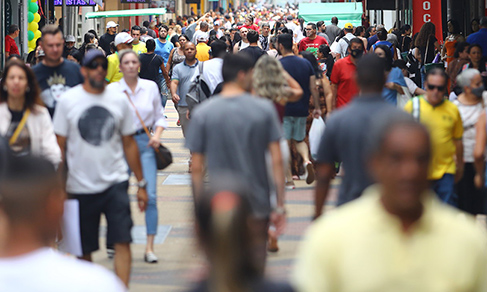
Brazil has 207.8 million inhabitants, shows preview of 2022 Census
The IBGE releases today (28) the preliminary population of the municipalities based on the data collected...
28/12/2022
2022 Census
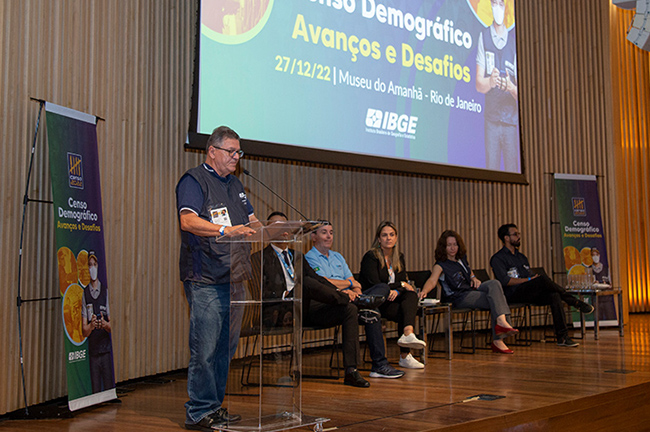
IBGE sends preview of municipal populations to TCU based on the 2022 Census
The IBGE sends today (28) to the Federal Court of Auditors (TCU) the preliminary population of the municipalities...
28/12/2022
2022 Census
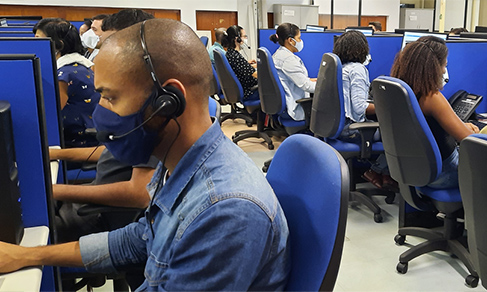
Households not yet enumerated should call Disk Census 137
Residents of households where nobody answered the 2022 Census should call Disk Census 137, which attends...
27/12/2022
2022 Census
Data collection by the IBGE and the news that stood out in 2022
August 1st, 2022 marked the start of one of the most complex surveys conducted by the IBGE, the Population...
26/12/2022
2022 Census
Across the street another country: the 2022 Census on the Brazil-Uruguay border
The flags fluttering side by side indicate: half of the park is Brazilian, half, Uruguayan. It is through...
19/12/2022
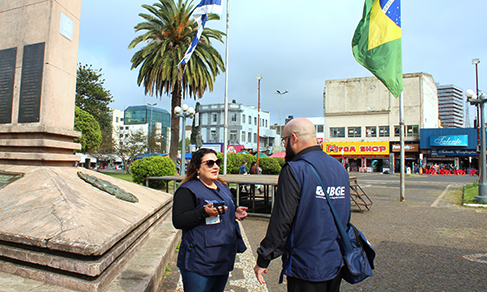
2022 Census
Census counts 168 million persons, nearly 80% of the population
The IBGE is releasing today the fourth report on the 2022 Population Census data collection Since the...
06/12/2022
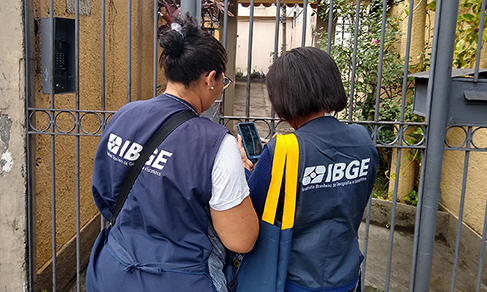
2022 Census
Copan: enumeration in the largest residential building in Latin America
“Something happens to my heart. Whenever I am at the corner of Ipiranga and São joão Avenue...”. The...
28/11/2022
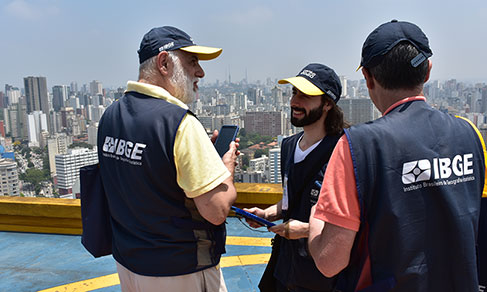
2022 Census
In Nova Iguaçu: 2022 Census reaches rural Rio de Janeiro
It was not before a week of heavy rain and mud, at the beginning of October, that the IBGE News Agency...
14/11/2022
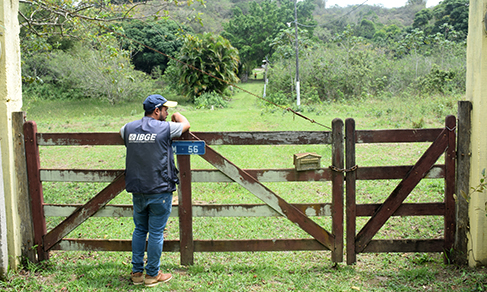
2022 Census
Census registers 136 million people, more than 60% of population
The IBGE is releasing today the third report of the 2022 Population Census. Since the beginning of the...
01/11/2022
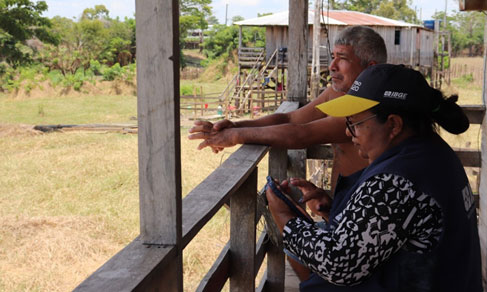
2022 Census
Careiro da Várzea: the Census in riverside communities in Amazonas
Living in the municipality of Careiro da Várzea, in Amazonas, means facing the river floods and drought...
31/10/2022

Errata
Updating of CSV files of Clusters by enumeration area 2010
Published date: 15/06/2026
Description:
Variable Cod_setor (1st column) of files in CSV format were corrupted.Actions: The files have been amended and replaced.
Replacement of publication 2022 Population Census: Nuptiality and Families: Preliminary Sample Results / IBGE
Published date: 12/11/2025
Description:
Flaws were found when processing the algorithm of identification of families, resulting in errors in the results produced for two municipalities - and hence for the aggregate results of the respective Federation Units, Major Region and for the national results of the Families theme.Actions: The complete publication has been replaced by a second edition amended and updated. The Sidra tables have been replaced as well.
Replacement of publication 2022 Population Census: Indigenous ethnicities and languages: Major sociodemographic characteristics: Population results
Published date: 25/10/2025
Description:
Amendment of four data in the first paragraph of page 223 of the complete publication. Instead of 99 languages, there are 97 languages for Manaus/AM; instead of 78, there are 77 languages for São Paulo/SP; instead of 61, there are 60 for Brasília/DF; and, instead of 68 languages, there are 36 for São Gabriel da Cachoeira/AM.Amendment of five data on pages 223 and 224 of the publication. On page 223, the value of 1 708 Municipalities was informed rather than 368 Municipalities; and of 389, rather than 19 Municipalities with 10 or more Indigenous languages spoken or used within Indigenous Lands. On page 224, 25 languages were informed, when the correct is 24 languages spoken in São Gabriel da Cachoeira/AM within Indigenous Lands. Values for Bom Jesus do Tocantins, in Pará, were also amended from 23 languages to 22 languages, and for Pacaraima, in Roraima, from 20 languages to 19 languages.
Actions: The complete publication has been replaced.
Replacement of vector files of product "2022 Statistical Grid"
Published date: 02/10/2025
Description:
It was noticed that the vector files of the 2022 Statistical Grid, in the 1km, 5km, 10km, 50km and 100km dimensions, did not contain cells without population and/or households, causing a spatial discontinuity. These vector files have been replaced by continuous versions, i.e., encompassing all the extension of the national territory.Actions: The files have been amended and replaced.
Replacement of files from the publication 2022 Population Census: Indigenous Localities
Published date: 19/09/2025
Description:
Inconsistencies were found in the formatting and content of the geospatial files for Indigenous Localities and Concentration Areas of Indigenous Peoples in the publication "2022 Population Census: Indigenous Localities," identified after its publication.Actions: All geospatial files for Brazil, including those for the states of Amazonas, Amapá, Tocantins, Alagoas, Santa Catarina, Rio Grande do Sul, and Mato Grosso do Sul, and those for the Federal District, were replaced.
Replacement of the SIDRA table from the 2022 Population Census - Religions - Preliminary Sample Results
Published date: 18/09/2025
Description:
The values in SIDRA table 10203 were calculated incorrectly.Actions: The table has been amended and replaced on the IBGE SIDRA platform.
Correction of files in the product Aggregated resuts by enumeration areas
Published date: 17/04/2025
Description:
Necessary corrections were made in the mesh of Enumeration Areas, causing the relocation of 18 housing units to a different enumeration area in the file “Agregados_por_setores_basico_BR.zip”. Variable V00003 had its name corrected from “Domicílios Coletivos Com Morador” to “Unidades de Habitação em Domicílios Coletivos Com Morador” in the file “Dicionário de dados”. Other 15 blank variables - V00236, V00243, V00250, V00257, V00280, V00281, V00282, V00283, V00284, V00303, V00304, V00556, V00563, V00570 and V00577 - were corrected in the files “Agregados_por_setores_caracteristicas_domicilios2.zip” and “Agregados_por_setores_caracteristicas_domicilios3.zip”.Actions: Replacement of files available for download on the release page an in the Methodological note no. 06/2024.
Replacement of publication Favelas and Urban Communities: population results / IBGE
Published date: 17/04/2025
Description:
Inconsistencies were found between the statistical and geographical databases of the 2022 Population Census, pinpointed during the final procedures of editing and checking of the statistical data aggregated by Enumeration Area. The population living in Favelas and Urban Communities changed from 16 390 815 to 16 390 790, whereas the total number of households changed from 6 556 998 to 6 556 968.Actions: The complete publication has been updated and replaced.
Replacement of publication Methodological notes no.07/2024: Sample expansion process for preliminary results
Published date: 30/01/2025
Description:
The amendment of the title of the methodological note referenced on page 11 of the publication was required.Actions: The publication has been replaced and the title of the methodological note, which talks about the construction of preliminary weighting areas, has been changed.
Correction of data in two graphs of the topic Indigenous peoples on the 2022 Census Overview website
Published date: 09/10/2024
Description:
The graphs "Population in indigenous lands" and "Indigenous lands by location of housing unit" of the 2022 Census Overview website presented incorrect data in the period between September 26 and October 04, 2024.Actions: The error was corrected on the 2022 Census Overview website in the afternoon of October 04.
Replacement of the publication 2022 Population Census: Indigenous Population: Literacy, birth records and characteristics of housing units, by specific areas: Population Results
Published date: 08/10/2024
Description:
Correction of two pieces of data in the last paragraph of page 42 of the complete publication. Instead of 24 municipalities, there are 25 where the proportion of the population living in housing units with a bathroom for exclusive use in 2022 was below 50% and, instead of 668 municipalities, there are 669 where this proportion was below 90%.
Five pieces of data on pages 164, 202, 218 and 219 of the publication were corrected. On page 164, the figure informed was 621 079 housing units, while the correct figure is 342 080 housing units. On page 202, the figure informed was 621 079 housing units, but the right figure is 516 176 housing units. On pages 218 and 219, percent changes were corrected from 9.42% to 9.39%; from 34.70% to 34.71%; and from 0.55% to 0.56%.Actions: The complete publication was replaced.
Replacement of 2022 Population Census: Characteristics of housing units: Population results publication
Published date: 05/06/2024
Description:
Amendment of two data in the last paragraph of page 42 of the complete publication. Instead of 24 municipalities, they are 25 in which the proportion of the population living in housing units with exclusive bathrooms in 2022 was lower than 50%, and, instead of 668 municipalities, they are 669 in which this proportion was lower than 90%.
Actions: The complete publication has been replaced.Error in release "Population and households - First results", specifically in results of municipalities Abel Figueiredo (PA) and São Pedro da Água Branca (MA)
Published date: 22/12/2023
Description:
Error in the data collection, pinpointed by the IBGE, in the inter-state border between Pará and Maranhão, in the municipalities of Abel Figueiredo (PA) and São Pedro da Água Branca (MA). The amendment caused the transference of a contingent of 894 persons and 330 households, being 265 occupied households with interviews from Abel Figueiredo (PA) to São Pedro da Água Branca (MA).Actions:
Tables SIDRA 4709, 4711, 4712 e 4714 of the "Population and Households -First Results" release with the amendments were made available on December 22, 2023.Observation:
The IBGE is producing a Technical Note, to be released soon, detailing this problem and showing all the actions aiming at its amendment.Error in release "Population by age and sex - Results of the universe", specifically in results of municipalities Abel Figueiredo (PA) and São Pedro da Água Branca (MA)
Published date: 22/12/2023
Description:
Error in the data collection, pinpointed by the IBGE, in the inter-state border between Pará and Maranhão, in the municipalities of Abel Figueiredo (PA) and São Pedro da Água Branca (MA). The amendment caused the transference of a contingent of 894 persons from Abel Figueiredo (PA) to São Pedro da Água Branca (MA).Actions:
Tables SIDRA 1209, 9514 e 9515 of the "Population by age and sex - Results of the Universe" release with the amendments were made available on December 22, 2023.Observation:
The IBGE is producing a Technical Note, to be released soon, detailing this problem and showing all the actions aiming at its amendment.Calendar error in the release of 2022 Population Census: Population by age and sex - Persons aged 60 years and over publication
Published date: 01/11/2023
Description:
Error, pinpointed by the IBGE, for not publishing the release date of the document titled "2022 Population Census: Population by age and sex - Persons aged 60 years and over" in the release calendar. The document was produced to complement the "2022 Population Census: Population by age and sex: Results of the universe" publication, released on October 27, 2023. Aware of the relevance of this theme, the text specifically deals with the population aged 60 years and over, which are the people considered Elderly persons according to the Statute of Elderly Persons.Actions: Release of a Highlight on the availability of the "2022 Population Census: Population by age and sex - Persons aged 60 years and over" document.